
Checking enchants before buying a replacement
A seemingly weak new item becomes competitive once both alternatives have comparable enchants.
Fictional development article. Characters, numbers and events below are illustrative, not product measurements or announcements.
A seemingly weak new item becomes competitive once both alternatives have comparable enchants. In this fictional field note, our group has a single evening available. We want a decision we can explain before anyone spends currency or changes equipment. The useful outcome is a short list of actions, with enough context that another player can check our reasoning.
Start with the question
Mira arrives with a bag full of possibilities and a limited upgrade budget. Her first instinct is to replace the oldest item. That is understandable, but age is not the question we need to answer. We write down the actual choice: which available outfit should she equip for the activity the group is planning tonight?
The distinction matters because the rest of the outfit stays part of the comparison. A ring can change the balance of secondary stats. A tier piece can complete a bonus. A weapon can compete with materials that would otherwise upgrade two smaller pieces. None of those choices can be explained by reading one item tooltip in isolation.
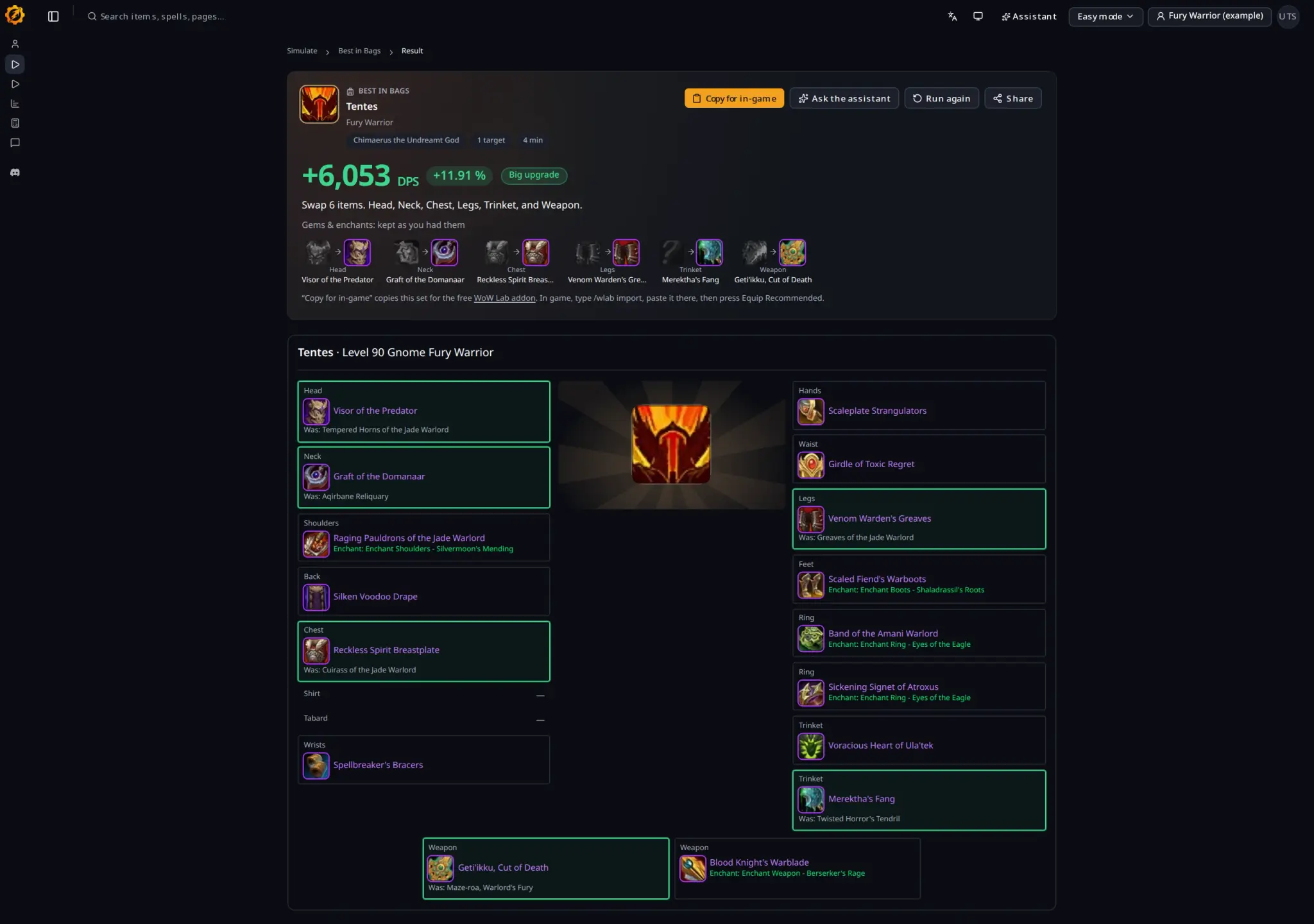
Before comparing, Mira checks that her character export includes the equipment she intends to use. She opens the WoW Lab addon in game, exports with /wlab, and imports the character. The group keeps the original outfit as a reference so that a later change has something concrete to compare against.
Make the comparison fair
We keep the activity and character consistent while changing the gear under consideration. If one candidate has an enchant and the other does not, the result answers a different question from the one we intended. Sometimes that is exactly what we need: the player may be deciding what to equip right now. Sometimes the intended question is what to buy after both items are prepared.
These two questions deserve separate notes. We do not quietly substitute a fully upgraded item for the one currently in the bag. Instead, we record the cost and the assumption alongside the candidate. This makes it possible to revisit the decision when another drop arrives without trying to remember what the earlier comparison meant.
Record only what changes the decision
Our notes are deliberately short. We include the candidate, the cost and any dependency on another item. We leave out details that would make the conversation harder to follow without changing the choice. The following table is invented to illustrate the format; it is not a prediction for any particular class.
| Candidate | Required work | Decision for tonight |
|---|---|---|
| Current outfit | None | Keep as reference |
| New drop | Enchant and one upgrade | Compare before spending |
| Crafted alternative | Materials and a craft | Revisit next reset |
| Tier alternative | Another set piece | Wait for the complete pair |
Read the result as a decision
The first result is a prompt to inspect the winning outfit. Mira checks which items changed, whether an expected set bonus is present and whether the recommendation assumes something she cannot obtain tonight. A result that requires unavailable equipment is still useful for planning, but it should not be confused with an immediate equip decision.
Small differences deserve calm discussion. If two choices are close enough that the result does not clearly separate them, convenience and flexibility may matter more than a dramatic claim about a tiny gain. Our group prefers an explanation that admits this uncertainty to one that promises a precise improvement in every encounter.
Keep a reproducible note
For this fictional review, we save a compact record next to the shared result. This is an example of a personal note, not an import format or an API request:
{
  "question": "What should Mira equip tonight?",
  "reference": "Current outfit",
  "candidate": "New drop with matching enchant",
  "decision": "Compare the complete outfits",
  "revisit": "After the next weekly reward"
}
The note prevents a common misunderstanding: a guildmate opens a result later and assumes it describes the character as it exists today. Equipment changes, and the original question can disappear from a conversation surprisingly quickly. A sentence explaining the comparison is often more useful than another screenshot of a number.
Bring the choice back to the group
Mira shares the result with the person helping her plan upgrades. They discuss the practical cost before doing anything irreversible. The raid leader does not need to learn every detail of the comparison; they need to know whether the player is ready, whether a craft is still outstanding and whether the next drop could change the plan.
For a larger roster, the same habit keeps requests manageable. Players can prepare their questions before the evening starts, compare their own candidates and bring back a concise decision. Shared access does not mean every person needs to run at the same moment. The group can plan its busiest period and choose capacity around that period instead of treating the roster count as a mandatory purchase quantity.
What we would do next
For tonight, we keep the reference outfit until the comparison supports a change we can actually make. We write down the next useful event: a new drop, enough currency for an upgrade, or a weekly reward. Repeating the same comparison with unchanged inputs would add work without helping the decision.
The lesson from this fictional evening is modest. Ask one concrete question, compare like with like, inspect the recommended outfit and keep a short explanation. A tool is most useful when it leaves the group with less uncertainty and more time to play together.